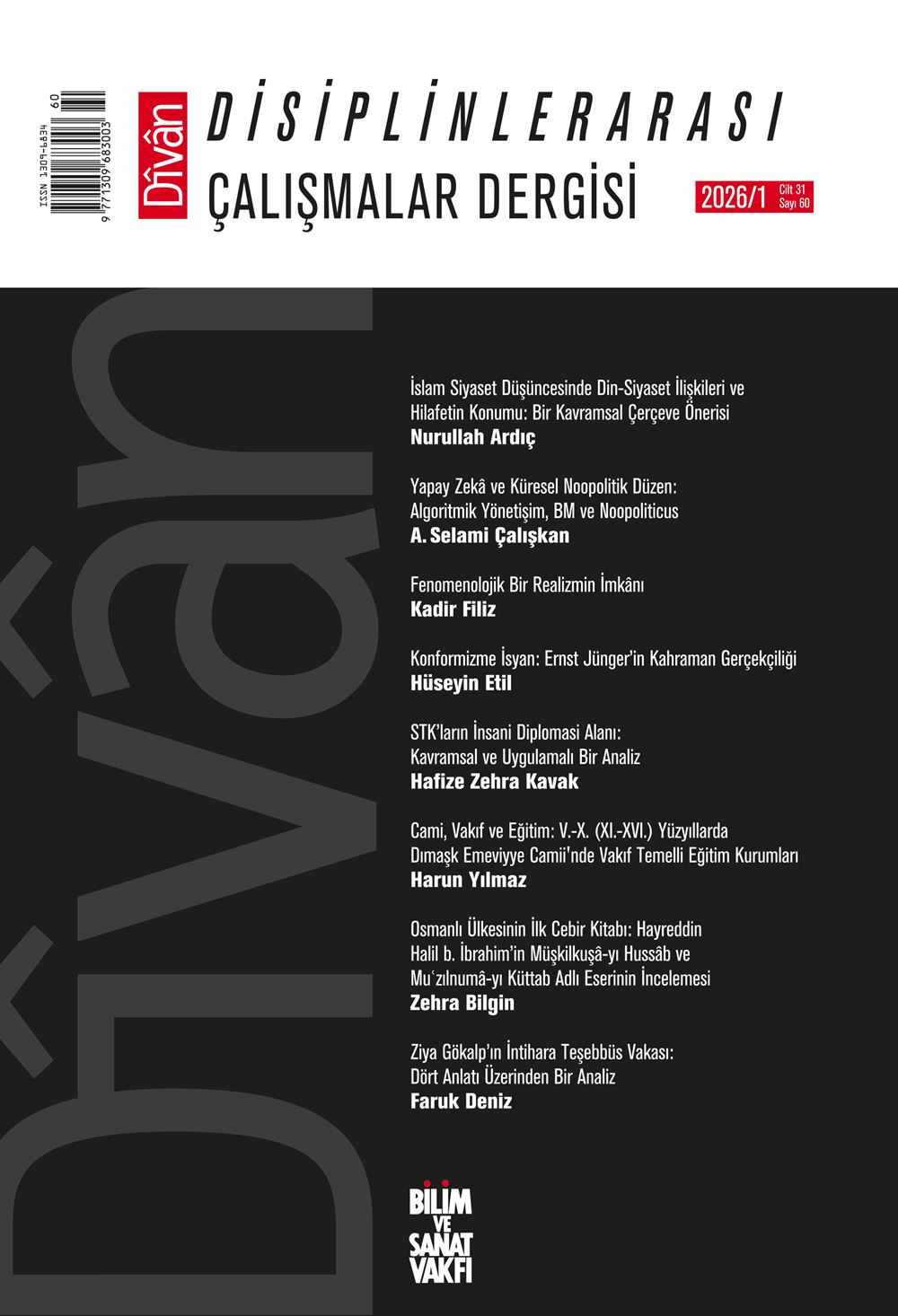
Disiplinlerarası Çalışmalar Dergisi Sayı 60
Articles
his article aims to contribute to resolving this confusion by proposing an explanatory conceptual framework, based on classical and modern perspectives, that addresses both the meaning of the caliphate and its position within mainstream Islamic political thought, as well as the relationships between religion and politics. Grounded in the tripartite distinction of “shar'ī (revealed)-religious-worldly,” this framework will argue that the imamate/caliphate is neither a “metaphysical-spiritual” nor a purely “political-secular” institution, but rather an authority of a “religious-political” nature.
Nurullah ARDIÇThis article examines existing examples of the use of Artificial Intelligence (AI) at the state and supra-state levels and analyzes the relationship between AI and the Global Noopolitical Order. First, the power of algorithms to produce social order is discussed through examples of their use in law, education, health, and politics. In this context, it is emphasized that algorithms should be open-source and auditable for democratic legitimacy and transparency.
Selami ÇALIŞKANSpeculative realism as a philosophical movement criticizes phenomenology by labeling it as “correlationist”. Behind this criticism, there is an understanding that phenomenology has a transcendental structure. I argue that phenomenology cannot be defined only under this particular conception of transcendental structure and there is a possibility of realist phenomenology. Phenomenology can offer a realist version of itself through its own possibilities, which Claude Romano, one of the contemporary phenomenologists, calls “descriptive realism”. In this article, first, I examine the concept of “correlationism” used by speculative materialists and realists to address phenomenology.
Kadir FİLİZModern societies are generally considered post-heroic societies. It has been thought that in modern conditions, where the market, the state, institutions, mechanisms, and individualism have developed and become established, there is no place for heroes in the classical sense. However, political and intellectual movements that challenge the modern order and aim to transcend it continue their search for heroism. This article will focus on the “heroic realism” of Ernst Jünger, a significant literary figure, thinker, and essayist who explored the possibilities of heroism in the modern era. Jünger attempts to embody the spirit of heroism in figures such as the “Soldier,” the “Worker,” the “Anarchist,” and the “Rebel.” According to him, World War I was a world-historical event that gave birth to heroic personalities.
Hüseyin ETİLIn this study, data gathered from the primary literature of four selected organizations, along with in-depth interviews conducted with their representatives, were analyzed through document analysis and in-depth interviews. Through the conceptual lens of Bourdieu’s sociology, the study aims to explore and understand the structural positioning of Turkish civil society organizations within the field of humanitarian diplomacy.
Hafize Zehra KAVAKThis article examines the emergence and functioning of waqf-based teaching circles within the Umayyad Mosque between the 11th and 16th centuries. Although scholarly activities in the Islamic world often took place in informal settings, sources such as al-Nuʿaymī’s al-Dāris fī tārīkh al-madāris provide valuable insights into the presence of long-standing teaching assemblies held within the mosque, supported by endowments and referred to by various names. The sabʿ circles, for example, were gatherings of hundreds of students focused on Qurʾanic recitation, while the mīʿād sessions stood out as systematic hadith lessons attended directly by the broader community. According to al-Nuʿaymī, over a thousand students participated in the sabʿ, clearly demonstrating the educational intensity within the mosque.
Harun YILMAZThis study aims to analyze the introduction and first chapter of Mushkilkushā-yı Ḥussāb by examining its manuscripts from the Ayasofya and Şehid Ali Paşa collections. The research explores the mathematical content, methodology, and instructional approach of the book, highlighting its significance as the earliest known algebra text written in the Ottoman Empire. By investigating the problem-solving techniques presented in the work, this study sheds light on the advanced mathematical training required for Ottoman accountants and scribes.
Zehra BİLGİNMehmet Ziya Gökalp, one of the leading intellectuals of modern Turkey, attempted suicide at the age of eighteen. In subsequent years, this incident gave rise to numerous and often conflicting accounts within both the history of political thought and the body of Gökalp scholarship. This article offers a comparative analysis of these divergent narratives and systematically elucidates the differences among them. Moreover, it demonstrates in a striking manner how such narratives have been employed in constructing an idealized biography of Gökalp, who is regarded as a foundational figure in the intellectual history of modern Turkey.
Faruk DENİZ